In the past, SEO was a simple game of matching “strings” of text. Marketers focused on keyword density and exact phrasing to rank. However, this “old way” often led to shallow, unhelpful content. Today, search has evolved into a sophisticated understanding of context and human language.
Consequently, we have moved into the era of Semantic Search. This shift prioritizes “things, not strings”. Modern algorithms now use Natural Language Processing (NLP) to understand the world like humans do. In this guide, you will learn how to master this transition.
What is Semantic SEO? (The Definition)
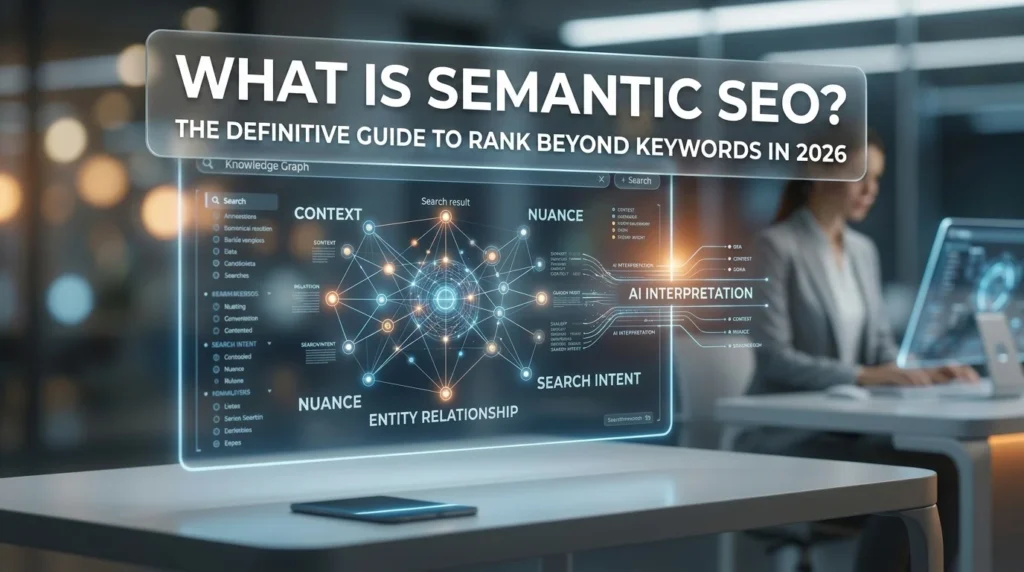
Semantic SEO is the process of giving web content more meaning and thematic depth. It goes beyond targeting a single keyword. Instead, it focuses on the Entity-Attribute-Relationship (EAR) framework.
Under this framework, search engines view the web as a collection of Entities (people, places, or things). For instance, Google’s Knowledge Graph understands that “Taj Mahal” is not just two words. It can be a monument, a musician, or a casino.
Semantic SEO ensures your content is cataloged around these contexts. Furthermore, it helps crawlers recognize your site as a high-quality, authoritative source. By focusing on meaning vs. intent, you provide answers that truly satisfy the user.
Why Semantic SEO is the New Standard for 2026?
Search engines no longer just provide links; they provide answers. With the rise of AI Overviews and Large Language Models (LLMs), the search landscape has changed.
The Rise of LLMs and AI
Google uses advanced models like BERT and MUM to grasp natural language nuances. These technologies analyze the “tone” and “context” of your writing. Consequently, search engines can now answer complex queries that lack a specific keyword match.
Building Topical Authority
Semantic SEO allows you to build topical authority. Rather than writing isolated posts, you create a web of interconnected ideas. This depth demonstrates expertise and trustworthiness to Google. In addition, it makes your site future-proof against algorithm changes.
The Core Components: Intent vs. Meaning
To succeed, you must understand the difference between what a user says and what they want. This is the heart of Search Intent.
The 4 Types of Search Intent
- Informational: The user seeks answers or facts.
- Navigational: The user wants to find a specific website.
- Transactional: The user is ready to make a purchase.
- Commercial Investigation: The user is comparing products before buying.
Interpreting Nuance
Algorithms use Semantic Distance (or proximity) to interpret meaning. They calculate the “distance” between different concepts in a Topic Map. For example, if you write about “running shoes,” the engine expects to see “sneakers” and “trainers” nearby. This contextual richness helps the engine understand your unique value.
How to Implement Semantic SEO? (Actionable Steps)
Transitioning to a semantic strategy requires technical and creative updates. Follow these steps to optimize your presence:
- Topic Clustering: Group your content into clusters around a core pillar.
- Schema Markup (JSON-LD): Use structured data to give engines explicit clues about your content.
- Entity Optimization: Include synonyms and related terms to enrich the narrative.
- Internal Linking: Connect related pages to create a strong architecture.
- Answer the Public: Use tools to find common questions your audience is asking.
The Future of Search: Moving Toward LLMO
The next frontier is Large Language Model Optimization (LLMO). In this phase, Information Gain becomes the primary ranking factor. Information Gain refers to the unique, additional value your content provides over existing sources.
As search engines move toward Retrieval-Augmented Generation (RAG), they will favor content that offers fresh insights. You must go beyond common knowledge. By highlighting Semantic Proximity between complex ideas, you help AI models synthesize better answers.
Conclusion
Semantic SEO is no longer optional; it is essential for growth. By shifting your focus from “strings” to “things,” you align with how Google actually works. This approach leads to higher topical authority and better user experiences.
Ultimately, these strategies drive higher conversion rates and long-term business success. Start building your Knowledge Graph today to stay ahead of the competition in 2026.
To give web content more meaning and thematic depth so search engines can understand it better.
The meaning and context behind the words used in a search query.
The specific goal or reason why a customer is performing a search.
The actual information and ideas conveyed by words, even if phrasing differs.
It prioritizes high-quality, relevant meaning over the repetitive use of keywords.